Office Relocation Services in Islington
If you are planning an office move in Islington, you already know it is rarely as simple as moving boxes from one place to another. Business premises in the borough can range from compact studios above shopfronts and shared workspaces to larger offices in converted buildings, townhouses, and modern developments. That means a successful move needs careful planning, the right equipment, and a team that understands the practical realities of working in central and North London.
Professional Office Relocation Services in Islington are designed to help businesses move with less disruption, less stress, and better control over timings. Whether you are relocating a small team, expanding into a bigger space, consolidating departments, or moving out of a property with tight access, a local team can make a huge difference. From initial planning to final set-up, the aim is to keep your move organised and your business moving forward.
Islington businesses often need moving support that takes into account busy streets, limited loading options, stair access, controlled parking zones, and the realities of shared entrances and neighbouring premises. A local office relocation service can help you manage these challenges efficiently while protecting equipment, documents, furniture, and sensitive items throughout the process.

Why businesses in Islington choose professional office relocation support
Office moves are usually time-sensitive. Every hour spent moving desks, IT equipment, filing systems, and office contents is time when staff are not fully working. That is why many local companies choose office relocation in Islington from an experienced team rather than trying to manage everything in-house. The right service can reduce downtime, improve coordination, and help you move on a schedule that suits your operations.
Another major reason is protection. Office equipment can be fragile, bulky, awkward to carry, or expensive to replace. Monitors, printers, servers, archive boxes, meeting tables, and ergonomic chairs all need careful handling. A professional moving team uses proper packing methods, lifting equipment, floor protection, and transport arrangements that reduce the risk of damage during loading, transit, and unloading.
There is also the question of organisation. A move is easier when every item has a place, every department knows the plan, and the process is broken into manageable stages. That is especially valuable for growing companies, professional practices, creative studios, charities, start-ups, and established firms that need a move handled with minimal interruption to clients and staff.

Office relocation services tailored to the local area
Islington has a mix of property types, street layouts, and access conditions that can make business moves more complex than in suburban locations. Offices near Upper Street, Angel, Clerkenwell borders, Holloway Road, and Canonbury may face different challenges, from restricted parking and traffic flow to narrow staircases and shared courtyards. That is why a local moving team with practical experience in the area is so useful.
Office relocation services in Islington are not just about lifting and transporting furniture. They often include a full move plan built around your site, your schedule, and your building requirements. This can involve pre-move surveys, packing support, dismantling and reassembly, careful handling of IT and office technology, and planning for building access such as lifts, loading bays, or timed entry windows.
For many businesses, the best result comes from a move that feels almost invisible to customers and clients. Local experience helps with that. A team familiar with the area can anticipate traffic, parking restrictions, delivery timing, and building access issues that might otherwise slow the move down.
Who uses office relocation services in Islington?
Office moves in Islington are needed by a wide range of businesses and organisations. Some are moving to a bigger space because their team has grown. Others are downsizing, changing location for better transport links, or repositioning their premises to suit hybrid working. Many need help moving between commercial units, serviced offices, co-working spaces, or converted properties that were never designed for simple move-in and move-out access.
The service is also useful for businesses that do not have time to coordinate a move internally. Office managers, facilities teams, directors, and operations staff often prefer to outsource the physical move so they can focus on business continuity, staff communication, and client responsibilities.
Typical customers include:
- Small and medium-sized offices
- Start-ups and growing teams
- Law firms, accountants, and professional practices
- Creative agencies and design studios
- Charities and non-profit organisations
- Retail offices and back-of-house business areas
- Co-working and shared workspace users
- Commercial tenants moving between local premises

What is included in an office move?
A good office move is more than just transport. The aim is to deliver a structured service that supports your business from the first planning conversation to the final placement of items in the new premises. Depending on your requirements, office moving support may include a combination of the following:
- Pre-move planning to identify timings, access issues, and the scale of the move
- Site assessments for both the current and new premises
- Packing materials for documents, office supplies, and fragile items
- Furniture dismantling and reassembly where needed
- Safe removal of office contents including desks, chairs, cabinets, and storage units
- Handling of IT and electronics with appropriate care
- Loading and transport using suitable vehicles for office contents
- Unloading and placement at the new site
- Help with document and archive moves
- Optional out-of-hours moving where required
Some moves are straightforward, while others are highly detailed and require coordination across multiple departments. A flexible service can accommodate either. The right mover will talk through what needs special attention, what can be packed ahead of time, and what should be handled on the day to keep the move efficient.
Tip: if your office contains specialist items, confidential records, or delicate equipment, make sure those details are included in the planning stage. That helps the move team prepare the right packing approach and allocate the right resources.
How office relocation works in practice
Most office moves follow a clear sequence, although the exact approach will depend on your building, your timescale, and the amount of equipment involved. A local provider offering office relocation services in Islington will usually begin by understanding the size of the move and the access conditions at each location. That allows the team to plan how many people are needed, what vehicle size is appropriate, and whether certain items need to be moved before the main relocation day.
The next stage is preparation. This might involve packing materials, labelling systems, de-cluttering decisions, and identifying which items should be moved first. It may also include disconnecting certain equipment ahead of time or ensuring that essential files and devices are kept separate for quick retrieval.
On moving day, the team typically arrives with the equipment and vehicle needed to carry out the relocation in a controlled way. Items are taken out carefully, loaded securely, and moved to the new premises. Once there, the team places furniture and boxes into their designated areas so the office can start becoming functional again as quickly as possible.
Common stages of an office move
- Initial enquiry and move discussion
- Review of the size and complexity of the relocation
- Planning for access, parking, timing, and building requirements
- Packing and labelling of items
- Disassembly of furniture or workstations if required
- Careful loading and transit
- Unloading, placement, and reassembly at the destination
- Final checks and move completion

Preparing for an office move in Islington
The better prepared your team is, the smoother the relocation is likely to be. Preparation helps reduce confusion and keeps everyone working from the same plan. This matters even more in Islington, where properties can have narrow access points, limited parking, and strict time windows for loading or deliveries.
A useful preparation checklist can include the following:
- Confirm your moving date and access arrangements early
- Tell staff what they need to pack and by when
- Label boxes by department, desk, or room
- Separate confidential paperwork from general office items
- Back up important digital information before the move
- Identify fragile or specialist equipment that needs extra care
- Measure large furniture to confirm it will fit through entrances, lifts, and stairways
- Check what parking or loading restrictions apply at both sites
- Decide which items must be set up first at the new office
- Inform landlords, building managers, and any relevant contractors
It can also help to appoint one internal contact person to coordinate with the moving team. That way, decisions can be made quickly if anything changes on the day. For larger offices, a simple floor plan of the new premises can be very useful so boxes and furniture can be placed where they belong from the outset.
Businesses often underestimate how much time is saved by pre-labelling. Even a simple colour-coded system can help desks, storage, and department-specific items reach the right destination faster. That means staff can resume work more quickly after the move.
Local access issues and why they matter
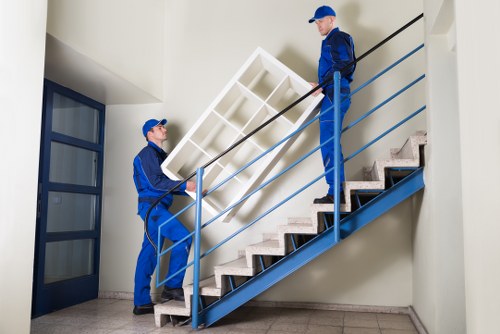
One of the biggest reasons to use a local moving company in Islington is familiarity with the area’s access challenges. Many office buildings in the borough are located on busy streets with controlled parking, one-way systems, or limited stopping space. Some premises have stairs without lifts, while others are in mixed-use buildings where careful coordination is needed to avoid disturbing residents or neighbouring businesses.
Parking restrictions can affect the pace of a move significantly. A team that understands how to plan around these constraints can help reduce delays and avoid avoidable problems. This can be particularly important if your move needs to be completed within a tight window, such as outside business hours or during a building management slot.
Local knowledge is valuable for navigating streets around Angel, Highbury, Barnsbury, Canonbury, Finsbury Park edges, and the roads connecting Islington with nearby commercial districts. It helps when loading plans have to be adapted to real-world conditions rather than ideal assumptions.
Examples of access challenges commonly found locally
- Narrow entrances and internal stairways
- Limited lift access or shared lifts in office buildings
- Restricted kerbside loading time
- Busy traffic during peak commuting hours
- Mixed residential and commercial buildings
- Long carries from vehicle to entrance
- Protection needs for communal areas and floors
Pricing factors for office relocation services
Businesses often want to know what affects the cost of an office move. While exact pricing depends on the details of the job, several common factors usually shape the quote. Understanding them helps you plan your budget more accurately and compare different service options in a fair way.
Typical pricing factors may include:
- Move size — the number of desks, chairs, cabinets, and boxes
- Distance between locations — local moves versus wider London relocations
- Access conditions — stairs, lifts, parking, loading restrictions, and carry distance
- Packing requirements — whether items are packed in advance or by the moving team
- Furniture dismantling — if desks and workstations need taking apart and rebuilding
- Special items — servers, fragile tech, archive storage, or bulky equipment
- Timing — standard hours or out-of-hours scheduling
- Complexity — multiple floors, phased moves, or split-site relocations
A detailed quote is usually the best approach because it reflects your actual requirements rather than a one-size-fits-all estimate. If your office move involves several departments or a staged relocation, be clear about that from the start so the quote can account for the full scope of work.
For many customers, the most valuable quote is not simply the cheapest one. It is the one that reflects the right level of preparation, support, and timing so the move goes smoothly and business disruption stays as low as possible. Request a free quote when you are ready to discuss the details of your office relocation in Islington.
Why a local company can be the smarter choice
Choosing a local provider for office relocation services in Islington can bring practical advantages that are hard to ignore. Local teams are often better placed to understand road conditions, building access patterns, and the pace of the area. They are also more likely to be familiar with common office types in the borough, from compact professional suites to larger multi-room premises.
Another benefit is responsiveness. If your schedule changes, or if there is a last-minute issue with access, a local team may be easier to coordinate with than a provider coming from much further away. That can be reassuring when you are managing a business move alongside everyday operations.
Local service also supports a more personal approach. Instead of a rigid, one-dimensional process, you can expect a move plan that takes account of your building, your business hours, and your team’s priorities. That is especially useful for offices that need to stay functional throughout the relocation or reopen very quickly afterwards.
What local experience often improves
- Timing around traffic and road access
- Understanding of local building layouts
- Planning for parking and unloading
- Coordination with building management
- Suitability for compact, busy, or shared premises
Areas covered around Islington
Office relocation support is commonly required across the wider Islington area and nearby districts. Businesses often move between central North London locations and surrounding neighbourhoods with strong transport links and active commercial activity. Depending on the job, services may cover places such as:
- Angel
- Upper Street and surrounding business locations
- Highbury
- Canonbury
- Barnsbury
- Holloway
- Finsbury Park edges
- King’s Cross borders
- Clerkenwell nearby business areas
- Archway and adjacent routes
Coverage can be especially helpful if your office move involves more than one site, or if your current and future premises are both in busy central areas where access needs careful coordination.
How to make the move easier for your team
Office relocation becomes much easier when everyone knows what to do before, during, and after the move. Even if you are outsourcing the physical work, there are still practical steps your staff can take to keep the process smooth. The goal is not perfection; it is clarity, structure, and reduced disruption.
For staff members, useful responsibilities may include packing personal work items, clearing desks before the move, labelling items correctly, and making sure any confidential materials are secured. For managers, it may involve creating a move timetable, coordinating departments, and identifying anything that should be unpacked first at the new office.
If your team is moving into a new layout, it can help to think in terms of zones. Reception, meeting areas, workstations, storage, and communal spaces should all be planned in advance so furniture and boxes can be delivered to the right place without unnecessary back-and-forth.
Practical tips for a smoother office move
- Start planning early rather than leaving tasks until the final week
- Keep essential documents and devices separate from general packing
- Use consistent labels on boxes and furniture
- Tell staff how to prepare their workstations
- Have a clear plan for IT setup and network access
- Check whether building rules affect lift use, loading, or noise
- Allow time for final checks before leaving the old premises
Frequently asked questions
How far in advance should I book office relocation services?
It is sensible to book as early as possible, especially if your move needs to happen on a specific date, outside normal hours, or within a busy part of Islington where access is limited. Early planning gives more time for surveys, packing preparation, and coordination with building management.
Can you move offices in stages?
Yes, many businesses prefer a phased move. This can be useful if you need to keep part of the office working while another section is relocated. A staged approach is often helpful for larger teams, shared premises, or businesses with essential client-facing operations.
Do office relocation services include packing?
They can. Some customers only need transport and lifting support, while others want help with packing, dismantling furniture, and organising boxes. The service can usually be adapted to suit how much assistance you want.
What about IT equipment and confidential files?
These items need extra care. IT equipment should be handled with suitable protection, and confidential files should be clearly identified so they can be moved securely and placed in the correct area at the new office.
Can an office move happen outside normal working hours?
Often, yes. Out-of-hours moves can be useful for reducing business disruption, though this depends on site access, building rules, and the move schedule. If you need evening or weekend support, mention it early when requesting a quote.
What if my office is in a building with poor access?
That is common in Islington, and it does not necessarily make the move difficult if it is planned properly. A local team can assess the access details and decide on the right equipment, manpower, and timing to manage stairways, lifts, and parking constraints safely.
Requesting a quote for your office move
If you are preparing for a business move, the best next step is to request a quote based on your actual requirements. A clear conversation about your current premises, your destination, your schedule, and any special items will help you receive an accurate proposal. That is the easiest way to compare options and choose the right moving support for your company.
When you enquire, be ready to share details such as the number of rooms, the amount of furniture, whether packing is needed, and any access problems at either site. If your office has restricted parking, narrow corridors, or shared entryways, mention those too. The more detail you provide, the easier it is to plan efficiently.
Contact us today to discuss your office relocation in Islington, and book your service now if you are ready to move forward with a local team that understands the area and the demands of business moving.
Final thoughts for Islington businesses
Moving an office is a big task, but it does not have to be overwhelming. With the right support, the process can be structured, efficient, and far less disruptive than many businesses expect. Whether you are moving a compact workspace near Angel, relocating a growing team in Highbury, or shifting a professional practice between commercial units in the borough, a local mover can help make the difference.
By choosing specialist Office Relocation Services in Islington, you get practical planning, careful handling, and local knowledge that helps the move run smoothly. That means less time worrying about loading bays, stairs, and furniture placement, and more time focusing on your business, your staff, and your clients.
If you are at the early stage of planning, now is a good time to start the conversation. If your move date is already set, request your quote and begin organising the details. A well-managed office move starts with the right support, and a local service is often the most efficient way to get there.